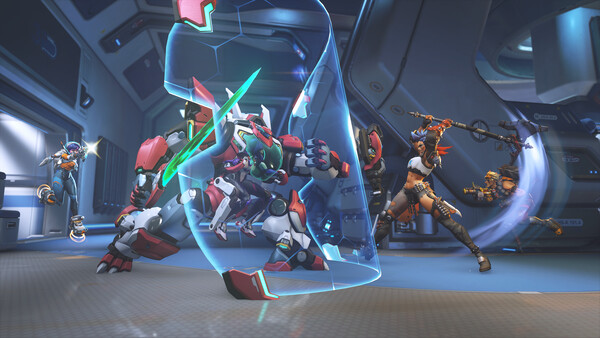
Turn a Push teamfight win into barricade distance
Read TS-1’s return route, activate forward spawns and play the overtime objective on standard Push maps such as New Queen Street, Colosseo and Esperança.

Read the distance markers before the opening fight
At the top of the screen, find the robot’s current location and each team’s best barricade distance. These are different measurements. The match can be even in eliminations while one team has a significant distance lead. At the start, both teams travel toward the same central robot. Choose an approach that lets your group arrive together when the objective unlocks. A player who reaches the robot early alone does not earn distance simply for being first on the scene.
Win control without losing sight of the objective
On symmetrical Push maps, the first engagement often develops on a side street or high ground overlooking the robot. Use that position to help the group, then confirm someone actually walks into the control area. TS-1 does not keep moving on behalf of a team that has entirely left it behind. Watch the objective icon after an apparent win. If the robot stands still, a surviving opponent may still be contesting or nobody from your side may be in range.
Distinguish the return journey from a scoring push
After the opposing team has moved the robot, reclaiming it first sends TS-1 back toward your own barricade. The robot can cover a long stretch without increasing your displayed record because it has not yet reached the barrier it needs to push. Do not mistake this for a score bug. Keep enough escort presence to finish the return while the rest of the team prepares for the next encounter near the stationary barricade.
Use bends and corners as regroup points
On New Queen Street or Colosseo, the walking route for the robot is not always the fastest route for a returning opponent. Watch nearby entrances and the next corner rather than assuming the other team must follow the track behind you. An escort player who is left unsupported can lose control even after the group won the previous fight. If allies are returning from spawn, avoid turning several separate arrivals into several consecutive lost engagements.
Understand when the forward spawn is active
Pushing the barricade past its checkpoint can grant the team a forward spawn. This shortens return travel and makes further escort more practical. Pay attention to the announcement and the spawn indicator after the robot changes sides. A forward spawn is tied to objective territory and can be lost as the robot crosses back. Do not plan a quick reinforcement around a spawn room your team no longer controls.
Decide whether to protect a lead or recover one
With a lead late in the match, keep the route to the robot accessible and do not hand the opponents an uncontested return through several corners. When behind, estimate the whole required journey: regain the robot, escort it to your barricade, then move the barricade beyond the opposing record. Saving a resource for the fight at that barrier can be more useful than spending everything to win a return leg that earns no distance by itself.
Handle the final contest deliberately
During overtime, leaving the contested objective at the wrong moment can end the match before a returning teammate reaches it. Read which side owns the robot, who must maintain the contest and where the lead marker lies. Communicate when the current escort player needs someone else to reach the objective. After a loss, compare the robot’s stopping point with your barricade’s record. That reveals whether the problem was losing the fight, abandoning the return trip or failing to convert control into new distance.
Official screenshots