Read your first Z-Team dispatch shift
Match emergency descriptions to the five hero stats, reserve a second responder and learn from the result chart. This is a mechanics guide for early Dispatch shifts without later story outcomes.
Read the call before opening the roster
At the SDN desk in the early episodes, a call's short description is your first hint about the type of responder required. Look for the action the public needs. A conversation with a crowd suggests a different profile from reaching a moving target or solving a technical problem. Name the two most plausible stats before looking at the heroes. That prevents the most visually prominent portrait from becoming your automatic choice.
Read all five spokes on the hero chart
The displayed attributes are Combat, Intellect, Vigor, Charisma and Mobility. A large number on one axis cannot explain how a hero will perform on every call. Compare the shape of their profile with what you inferred from the wording. For example, a strong communicator is an attractive candidate for a public-facing problem, but a second physical or travel-related requirement may make a different combination more suitable.
Check the dispatch window and availability
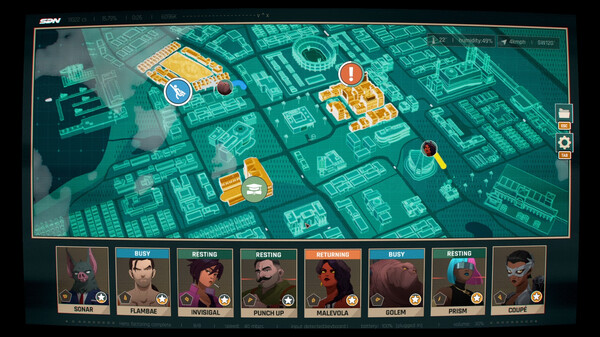
Look at the time remaining before committing. A specialist away on another call cannot immediately solve the new one. Compare the available roster with how soon each returning hero could be useful again. If time is already tight, sending an adequate available choice can be a better decision than waiting for the mathematically preferred hero until the call disappears.
Use multi-hero slots for complementary coverage
Some calls accept more than one responder. Inspect the combined profile after adding the first hero. Choose a partner who covers an obvious weak axis instead of doubling the strongest attribute without reading the job. Then check who remains at the desk. Spending two versatile heroes on an easy assignment can leave the next concurrent call without a plausible response.
Discover each hero's own power
The Z-Team members have individual powers in addition to their starting stats. These become clear as you dispatch them and encounter their conditions. Read the revealed description when a power appears, then consider a future call where the condition can actually trigger. A hero whose special power depends on a successful assignment or a particular pairing should be evaluated differently from a hero with a similar-looking base chart.
Use the result to refine the next prediction
After a call resolves, compare the revealed requirements with the words you treated as clues. A failed assignment may point to a missing stat rather than an entirely unsuitable hero. Make a short mental note such as a crowd-management call needing more Charisma. The result screen gives feedback specific to this assignment, which is more actionable than ranking the whole team by a single number.
Spend upgrades where the roster repeatedly falls short
When a hero gains an upgrade, look at the previous few assignments and identify a repeated gap. You can sharpen an established specialist or make a frequently dispatched multi-role responder less dependent on a partner. Evaluate the change on later call shapes while keeping rest and availability in mind. A stronger chart still cannot help while the hero is busy elsewhere on the city map.
Compare Prism's ordinary assignment with a copy-enabled one
Open Prism's character information and read the power she currently has, especially after a progression choice. A later option called Perfect Copy gives her duplication illusions the full stats of the copied hero. That description only applies once the option is available and actually selected. For a dispatch with more than one slot, compare the displayed requirements with the character Prism could copy. Duplicating a strong match can reinforce a narrow requirement, while duplicating a poor match simply repeats the original weakness. For the next call, try two heroes whose charts complement each other instead and compare their coverage on its demands. If an expected benefit never appears, check Prism's current power description rather than assuming every copy has final-tier statistics. Also look at the countdown before assigning two valuable people. Their time away can leave a simultaneous call with a much thinner roster.
Official screenshots